
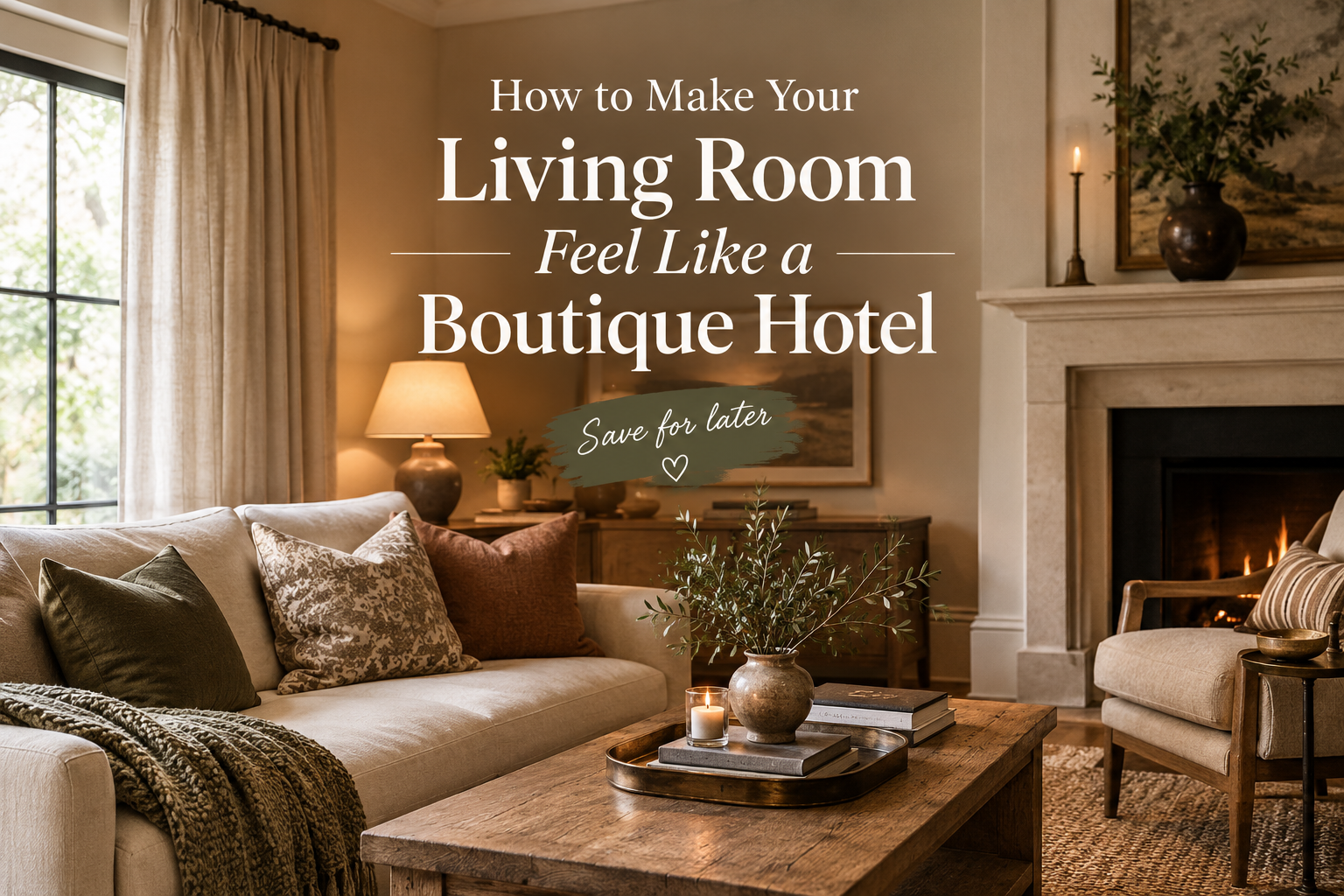
There is a certain feeling you get when you walk into a really beautiful boutique hotel.
The room feels polished, but not perfect. Comfortable, but not cluttered. There is usually something interesting to look at, but nothing feels like it was placed there simply to fill an empty surface.
Most importantly, the room feels good.
That is the part worth bringing home.
You do not need a designer sofa or a complete living room makeover to create the same atmosphere. In fact, some of the most effective changes are surprisingly simple: softer lighting, better proportions, layered textures, natural materials and a few pieces that give the room some personality.
The goal is not to make your living room look like a hotel lobby.
It is to create that same sense of quiet comfort and understated luxury — a room that feels inviting when you walk through the door and even better when you sit down at the end of the day.
And that approach fits where living room design is heading in 2026. Designers are increasingly favoring warmer, more layered and more personal rooms over perfectly coordinated, showroom-like spaces. Vintage pieces, natural finishes, mixed furniture and tactile textiles are all being used to give rooms more character.
Start With the Feeling You Want the Room to Have
Before buying anything, think about how you want your living room to feel.
Maybe you want it to feel calm and sophisticated.
Maybe you want it to feel warm and welcoming when friends come over.
Or perhaps you simply want it to feel a little more finished without replacing everything you already own.
That feeling should guide the decorating decisions.
A boutique hotel does not usually rely on dozens of unrelated decorative objects. Instead, the room has a visual language: a restrained color palette, comfortable furniture, beautiful lighting and a few memorable details.
You can do the same at home.
Choose a simple color story
You do not have to make your living room completely neutral.
Warm cream, oatmeal, taupe, olive, chocolate, muted rust and soft charcoal can all work beautifully together.
The important part is repetition.
If you introduce olive green in a pillow, for example, let a small piece of artwork, a vase or another accessory quietly repeat that color somewhere else in the room.
This makes the space feel collected rather than randomly decorated.
Warm, nuanced neutrals are particularly relevant right now, with designers favoring earthy browns, warm whites and layered tones that feel comfortable rather than stark.
Let Lighting Do More of the Work
If you only change one thing in your living room, consider changing the lighting.
A beautiful room can feel completely different under one bright ceiling light compared with several softer sources placed around the room.
Boutique hotels understand this very well.
Use several sources of light
Instead of relying on one central fixture, try combining:
- a table lamp
- a floor lamp
- a reading lamp
- wall lighting
- a dimmable overhead fixture
You do not need all of them.
Even adding one warm table lamp to a dark corner can change the atmosphere dramatically.
The goal is to create little pools of light rather than illuminating the entire room equally.
Choose warm light for evenings
When you want the room to feel relaxing, warm lighting works much better than a harsh, cool white bulb.
Think about the time of day when you actually use your living room.
If evenings are when you read, watch television, have a drink or talk with family and friends, the lighting should support that mood.
Current interior design trends are also treating lighting as part of the atmosphere rather than simply a functional necessity, with organic shapes and tactile materials becoming more prominent.
Make the Sofa Look More Inviting
Your sofa is probably the largest visual element in the room, so small styling changes here can have a surprisingly large effect.
You do not need to replace it.
Instead, look at how it is styled.
Layer pillows without overcrowding
A boutique-inspired sofa should look comfortable rather than covered in cushions.
Try combining two or three different textures instead of buying several pillows in exactly the same fabric.
For example:
A linen-look pillow.
A soft woven texture.
One deeper accent color.
The variation creates interest without making the sofa feel busy.
Add one beautiful throw
A throw draped casually over the arm or back of the sofa can make the room feel softer immediately.
Choose something with visible texture — cotton, wool, linen or a chunky woven finish.
The important thing is that it looks like something you would actually reach for.
That is part of the current shift toward rooms that feel lived in rather than staged. Designers are increasingly using texture to add depth instead of relying on color alone.
Use a Rug to Ground the Whole Room
A rug does much more than make the floor softer.
It visually connects the furniture and gives the seating area a sense of definition.
If your rug is too small, the furniture can look disconnected.
A larger rug that sits under at least the front legs of the main seating pieces usually creates a more intentional arrangement.
Think about texture before pattern
You do not need a dramatic patterned rug.
A textured neutral rug can be just as effective, especially if the rest of the room already has several visual elements.
Wool, jute, subtle geometric textures and vintage-inspired patterns can all add warmth.
And if your room is mostly neutral, a rug is one of the easiest places to introduce a little depth without overwhelming the space.
Bring in More Natural Materials
One of the easiest ways to make a living room feel more sophisticated is to stop relying on one material everywhere.
If you have a fabric sofa, for example, introduce wood, ceramic, glass, metal or woven materials around it.
The contrast makes the room feel richer.
Mix wood with softer materials
Warm wood is particularly effective because it adds visual warmth to pale upholstery and neutral walls.
Try a wooden coffee table, side table, picture frame or cabinet.
You do not need everything to match.
In fact, perfectly matching furniture is one of the things current living room design is moving away from. Designers are increasingly mixing furniture styles and finishes to create rooms that feel collected over time.
Add something imperfect
A handmade ceramic vase.
An old wooden bowl.
A vintage frame.
A slightly irregular piece of pottery.
These small imperfections make a room feel more personal.
The goal is not to make everything look brand new.
It is to make the room feel like it has a story.
Create One Strong Focal Point
A boutique hotel room usually has something that catches your eye.
Your living room should have one too.
It might be:
- a large piece of artwork
- a fireplace
- an interesting coffee table
- a beautiful lamp
- a large mirror
- a vintage cabinet
- a statement chair
The mistake is trying to make everything the focal point.
If every object is competing for attention, nothing stands out.
Give the eye somewhere to rest
If you already have a strong television wall, fireplace or large window, you may not need another statement feature.
Instead, build around what the room already gives you.
This is often more effective — and less expensive — than trying to completely redesign the space.
Make Your Coffee Table Feel Collected
A coffee table can easily become a dumping ground for remotes, mail, chargers and random objects.
A simple tray can change that.
Place a few intentional items inside:
- one or two books
- a small vase
- a candle
- a decorative object
Then leave some of the surface empty.
That balance between styled and empty is important.
Use books for more than decoration
Books can add color, height and personality.
Choose books you genuinely like rather than buying them purely because their covers match the room.
A boutique-inspired room should feel like someone actually lives there.
Hang Curtains to Soften the Room
Curtains can completely change the proportions of a living room.
If they are too short or mounted directly above the window, the room can feel smaller and less finished.
For a more elevated look, consider mounting the curtain rod higher and wider than the window frame and allowing the fabric to fall close to the floor.
Layer curtains when it makes sense
Sheer curtains can soften daylight while heavier drapes provide privacy and evening warmth.
Layering window treatments is also part of the broader move toward tactile, flexible interiors in 2026. Designers are increasingly using multiple textures and layers rather than treating windows as an afterthought.
You do not need elaborate custom treatments.
Simple, full-length curtains in a natural-looking fabric can make a surprisingly big difference.
Give the Room a Place to Read or Unwind
One of the things that makes a hotel-inspired living room feel luxurious is that it encourages you to stay.
Create one small area designed for exactly that.
A comfortable chair beside a lamp.
A small table.
A book.
Maybe a throw.
That is enough.
It does not need to be a huge reading nook.
Even an unused corner can become a destination when you give it a purpose.
Mix Something Old With Something New
This is one of my favorite ways to make a room look more expensive without actually spending more.
Instead of buying everything from the same collection, mix different eras and finishes.
A modern sofa can sit beside a vintage side table.
A contemporary lamp can sit on an antique cabinet.
A new rug can work with an older wooden coffee table.
This creates the collected feeling that designers are increasingly embracing in 2026. Vintage and secondhand pieces are being used to give modern living rooms more depth, history and personality.
And it means you do not have to start over every time you want your room to feel different.
Keep the Room Personal
There is a fine line between a sophisticated room and a room that feels anonymous.
You want the first.
That means keeping some things that actually mean something to you.
Maybe it is artwork from a trip.
A family photograph in a beautiful frame.
A vintage piece you found while traveling.
A stack of books you have actually read.
A ceramic piece from a local artist.
Those details are what keep an elevated room from becoming generic.
Architectural Digest’s 2026 interior forecast points toward more eclectic, personalized interiors, with texture, color, pattern and ornament being used to make spaces feel individual rather than algorithmically perfect.
Do Not Fill Every Empty Space
This may be the hardest part.
When a room feels unfinished, the instinct is often to buy something.
Another vase.
Another pillow.
Another piece of wall art.
But empty space is not necessarily a problem.
Sometimes the room simply needs time.
Leave a shelf partially empty.
Let a coffee table have open space.
Do not put furniture into every corner.
A room with breathing space often feels calmer and more sophisticated than one where every surface has been decorated.
Think About the Room at Night
One of the easiest ways to improve your living room is to stop looking at it only during the day.
Turn off the overhead light.
Close the curtains.
Turn on your lamps.
Sit on the sofa.
What do you notice?
Maybe one corner feels too dark.
Maybe the room needs another small lamp.
Maybe the coffee table feels too crowded.
Maybe the lighting is beautiful exactly as it is.
This little exercise can reveal much more than rearranging furniture for an afternoon.
The Boutique Hotel Formula Is Simpler Than It Looks
You do not need every trend or every expensive-looking accessory.
Start with the basics.
Comfortable furniture.
Warm layered lighting.
A rug that grounds the space.
Several different textures.
Natural materials.
A restrained color palette.
One or two pieces with character.
Enough empty space to let everything breathe.
That combination is what creates the feeling.
And it is why a room can look elevated without looking expensive.
Final Thoughts
Making your living room feel like a boutique hotel is less about buying new things and more about becoming intentional with the things you already have.
Soften the lighting.
Layer the textures.
Add warmth through wood and natural materials.
Give the sofa room to breathe.
Choose one or two pieces that tell a story.
And do not be afraid to leave some spaces empty.
The most beautiful rooms rarely feel like they were decorated all at once.
They feel collected.
They feel comfortable.
And they feel like someone actually lives there.
That is the kind of luxury worth creating at home.