
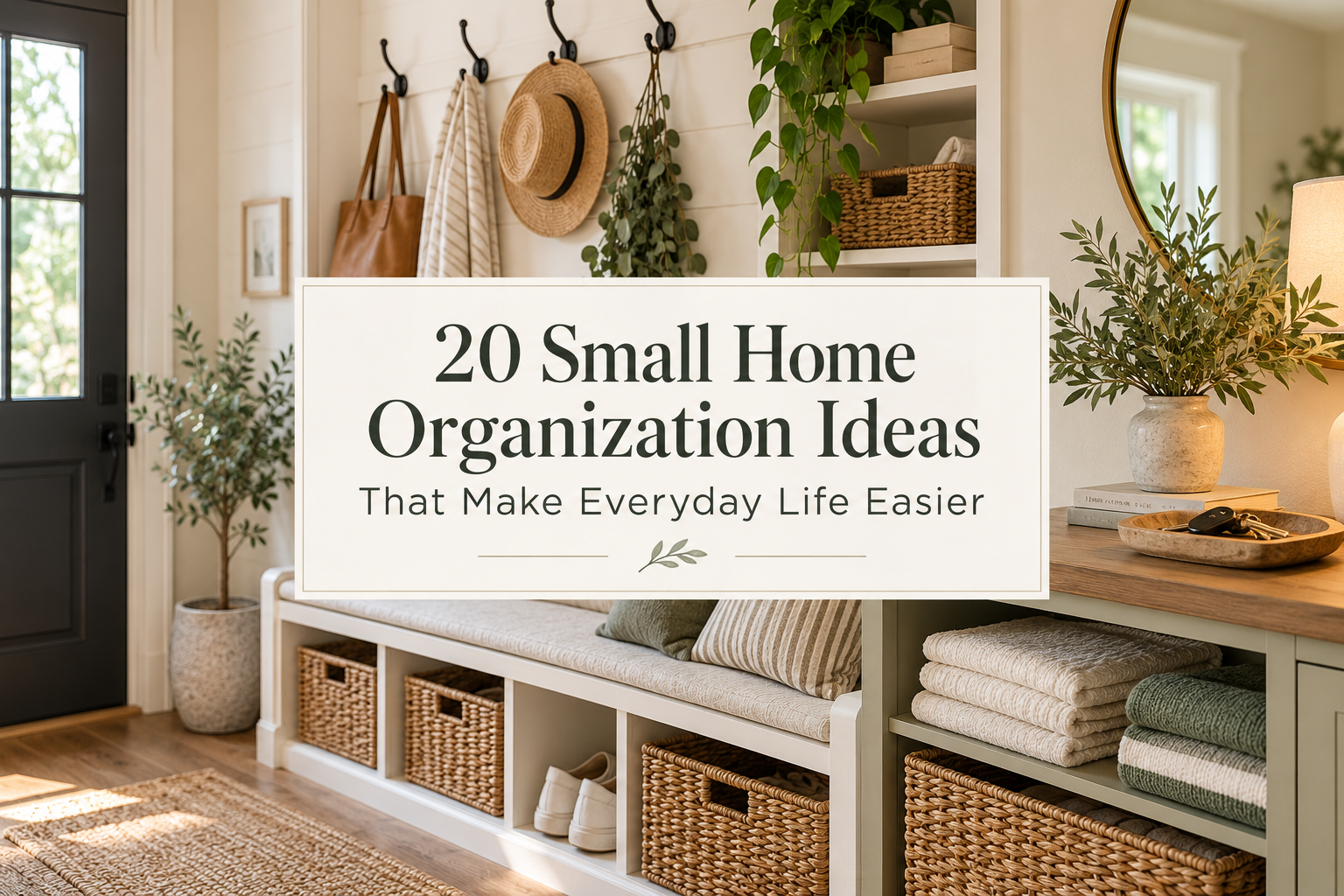
A more organized home does not require dozens of matching containers or an entire weekend spent decluttering.
Often, the biggest difference comes from fixing the small areas that create friction every day.
The shoes that never have a place.
The kitchen drawer you avoid opening.
The bathroom counter that fills up overnight.
The pile of mail that seems to appear no matter how often you clear it.
Good organization is not about making your home look perfect.
It is about making everyday life easier.
These small home organization ideas focus on simple systems, realistic storage and practical changes you can actually maintain.
This post may contain affiliate links. I may earn a small commission from qualifying purchases at no extra cost to you. As an Amazon Associate I earn from qualifying purchases.
Start With the Spaces You Use Most
Before buying organizers or emptying every cabinet, pay attention to where clutter naturally collects.
Those areas usually tell you exactly where your home needs a better system.
Common problem spots include:
- the entryway
- kitchen counters
- bathroom counters
- bedside tables
- laundry areas
- pantry shelves
- refrigerator doors
- drawers
- closets
Start with one.
A small improvement you maintain is far more useful than reorganizing the whole house and feeling overwhelmed a week later.
1. Create a Landing Zone Near the Door
The entryway is often where clutter starts.
Keys, bags, shoes, mail and jackets tend to land wherever there is space.
Create one simple landing zone instead.
You might use:
- a small tray for keys
- hooks for bags
- a basket for shoes
- a bowl for sunglasses
- a narrow console for mail
Keep It Small
A simple wooden catchall tray can keep keys, sunglasses and other small everyday items from spreading across the entryway.
The goal is not to store everything near the door.
It is simply to give the things you use every day a predictable place.
That alone can make mornings feel much easier.
2. Use a Basket for Things That Belong Elsewhere
One of the easiest ways to keep clutter from spreading is to use a simple “return later” basket.
A small woven storage basket can make this system feel more intentional while keeping loose items contained until you are ready to put them away.
Place one in a central area.
Whenever you find something that belongs in another room, put it in the basket instead of leaving it on the nearest surface.
At the end of the day, carry the basket around the house and return everything.
This works particularly well in homes where small items seem to migrate constantly.
3. Give Every Kitchen Counter Item a Reason to Stay
Kitchen counters easily become storage space for things that do not actually need to live there.
Take everything off one section of the counter.
Then put back only the items you use regularly.
For example:
- coffee maker
- kettle
- fruit bowl
- cutting board
- utensil crock
Everything else can usually move into a cabinet or drawer.
Leave Breathing Room
Even a small amount of empty counter space can make a kitchen feel more organized.
It also makes cleaning much faster.
4. Organize One Drawer by Category
You do not need to tackle every drawer at once.
Choose the one that frustrates you most.
Empty it completely.
Remove anything that belongs somewhere else.
Then group what remains into simple categories.
For example, a kitchen drawer might contain:
- measuring tools
- clips
- small utensils
- bottle openers
A bathroom drawer might contain:
- skincare
- hair accessories
- dental care
- makeup
The important part is not the organizer itself.
It is creating clear categories so you know where things go.
5. Use Vertical Space Inside Cabinets
Small homes often have more usable vertical space than people realize.
A 2-tier cabinet organizer can help you use vertical space more efficiently while keeping everyday items easier to see and reach.
Inside cabinets, you can add:
- shelf risers
- stackable bins
- small baskets
- tension rods
- hooks
This can be especially useful for plates, mugs, cleaning supplies and pantry items.
Avoid Stacking Too Deeply
If you have to remove five things to reach one item, the system is probably too complicated.
Good organization makes things easier to access, not harder.
6. Create a Simple Refrigerator System
A well-organized refrigerator can make meal planning easier and help you use food before it is forgotten.
You do not need a perfectly styled fridge.
Start with a few practical zones.
Top Shelf
Leftovers and ready-to-eat foods.
Middle Shelf
Dairy, eggs and everyday ingredients.
Lower Shelf
Meal components and ingredients for dinner.
Drawers
Produce.
Door
Condiments and drinks.
Pinterest has recently reported strong interest in refrigerator organization and similar reset-style home systems, which makes this a very current topic for home-content audiences. Thrifty and Bright
7. Add a “Use First” Bin
One of the most useful refrigerator systems is also one of the simplest.
A clear refrigerator storage bin makes it easy to create a visible “use first” zone for leftovers, yogurt, produce and opened ingredients.
This might include:
- half an avocado
- berries
- open cheese
- leftovers
- yogurt
- chopped vegetables
A visible “use first” area makes it much easier to remember what needs attention.
It can also reduce unnecessary food waste.
8. Store Similar Pantry Foods Together
Instead of organizing pantry shelves by package size, organize by purpose.
Useful categories might include:
- breakfast
- baking
- snacks
- pasta and grains
- canned food
- sauces
- quick meals
This makes it easier to see what you already have.
It also helps when making a grocery list because missing categories become obvious.
For more help building a flexible grocery routine, see The Ultimate Grocery List: Smart, Affordable Foods to Buy. Thrifty and Bright
9. Keep Everyday Items at Eye Level
The things you use most should be the easiest things to reach.
That sounds obvious, but many storage spaces are organized around where items fit rather than how often they are used.
Move everyday items to the most accessible shelves.
Save high shelves and awkward corners for:
- seasonal items
- backups
- occasional serving pieces
- rarely used appliances
Organization should match your actual habits.
10. Create a Small Cleaning Caddy
If your cleaning supplies are scattered across several cabinets, even a five-minute cleanup can feel more complicated than necessary.
Put your most-used supplies in one small caddy.
For example:
- multipurpose spray
- microfiber cloths
- glass cleaner
- scrub brush
- gloves
You can carry it from room to room instead of repeatedly looking for supplies.
This kind of small, manageable cleaning routine fits well with the current trend toward shorter home-reset systems instead of marathon cleaning sessions. Thrifty and Bright
11. Simplify the Bathroom Counter
Bathroom counters become cluttered quickly because so many routines happen in a small space.
Remove everything.
Then return only the products you use every day.
Everything else can go into:
- a drawer
- medicine cabinet
- basket
- vanity storage
Use One Tray
A small tray can visually group everyday products and make the counter feel more intentional.
If you want to make the room feel more polished as well, see How to Make Your Bathroom Feel Like a Luxury Hotel.
12. Add Hooks Where Things Naturally Land
Hooks are one of the easiest organization tools because they use wall space rather than floor space.
Add them where you naturally remove or use things.
Good locations include:
- behind doors
- inside closets
- entryways
- laundry rooms
- bathrooms
- bedrooms
Use them for:
- robes
- bags
- jackets
- towels
- hats
- reusable shopping bags
Put the hook where the behavior already happens.
That makes the system much easier to maintain.
13. Use Under-Bed Storage Carefully
Under-bed space can be useful, but it can also become a place where forgotten belongings disappear for years.
Use it intentionally.
Good items for under-bed storage include:
- seasonal bedding
- off-season clothing
- spare linens
- travel bags
- rarely used shoes
A set of under-bed storage bins can help you keep seasonal bedding, off-season clothing or extra linens contained without taking up valuable closet space.
Avoid using the space as a permanent hiding place for random clutter.
14. Make Your Nightstand Easier to Maintain
A cluttered bedside table can make the bedroom feel messy even when everything else is fairly tidy.
Try keeping only a few essentials nearby:
- lamp
- book
- water
- phone charger
- small tray
Move old receipts, paperwork, extra skincare and random objects somewhere else.
For more bedroom ideas, see How to Make Your Bedroom Feel Like a Luxury Hotel.
15. Create a Better Laundry Drop Zone
Laundry organization does not start in the laundry room.
It starts where clothes come off.
Put hampers where they are actually needed.
That might mean:
- one in the bedroom
- one near the bathroom
- a small one for towels
- separate baskets if sorting helps your household
Small-space laundry organization is also a particularly useful angle because it solves a recurring practical problem instead of treating organization as purely decorative. Thrifty and Bright
16. Keep a Donation Bag Going
Decluttering is easier when you do not need to create a major project every time you want to remove something.
Keep one bag or box in a closet.
Whenever you find something you no longer use, place it inside.
When the bag is full, donate it.
This turns decluttering into a habit instead of an event.
17. Use Small Containers Inside Large Storage Areas
Large drawers and cabinets often become messy because there is too much open space.
Smaller containers create boundaries.
You can use them for:
- hair accessories
- batteries
- cables
- medicine
- snacks
- cleaning cloths
- office supplies
You do not need expensive matching bins.
Simple boxes or containers you already own can work perfectly well.
18. Create a Paper System Before Paper Becomes a Pile
Mail and paperwork can become clutter very quickly.
Create three simple destinations.
Act
Bills, forms or paperwork requiring attention.
File
Documents you need to keep.
Recycle
Anything you do not need.
Try to process mail near the place where you bring it into the house.
The fewer times paper moves around, the less likely it is to become a permanent pile.
19. Reset One Small Space Each Week
Instead of waiting until the entire house feels disorganized, choose one small space each week.
For example:
Week 1: one drawer
Week 2: refrigerator
Week 3: bathroom cabinet
Week 4: entryway
This approach is easier to maintain because it breaks organization into smaller, repeatable routines instead of one huge project.
If you want a full weekly routine around this idea, see 15 Sunday Reset Ideas for a Calmer, More Organized Week.
20. Stop Organizing Things You Do Not Need
Sometimes the best organization solution is not another container.
It is owning fewer things in that category.
If a drawer is constantly overflowing, ask whether everything inside deserves to stay.
If a cabinet requires complicated stacking, you may simply have too much stored there.
Organization becomes much easier when the amount you own fits comfortably into the space you have.
Make Room for Everyday Life
A little empty space is useful.
Not every shelf needs to be full.
Not every drawer needs to hold more.
A home often feels calmer when storage has room to breathe.
A Simple Room-by-Room Organization Checklist
If you want to start without feeling overwhelmed, use this quick list.
Entryway
- Create a key drop
- Add hooks
- Limit shoes
- Sort mail
Kitchen
- Clear counters
- Organize one drawer
- Create refrigerator zones
- Group pantry foods
Bathroom
- Clear counters
- Create everyday-product storage
- Add hooks
- Remove empty products
Bedroom
- Clear the nightstand
- Put laundry in one place
- Use under-bed storage intentionally
- Remove clothing you no longer wear
Living Room
- Create a basket for loose items
- Clear the coffee table
- Store remotes together
- Keep blankets contained
Organization Does Not Have to Look Perfect
A functional home does not need to look like an organizing catalog.
Your containers do not need to match.
Labels are optional.
Pantry shelves do not need to look identical.
What matters is whether you can find what you need and put it away easily.
The best systems are usually simple enough that you can maintain them on a busy day.
Final Thoughts
A more organized home is usually built through small changes, not one enormous decluttering session.
Start with the places that create the most frustration.
Give everyday items predictable homes.
Use the space you already have more intentionally.
And do not be afraid to remove things instead of finding another way to store them.
The goal is not a perfect home.
It is a home that supports your routines, reduces unnecessary decisions and makes everyday life feel easier.
That is the kind of organization worth keeping.