
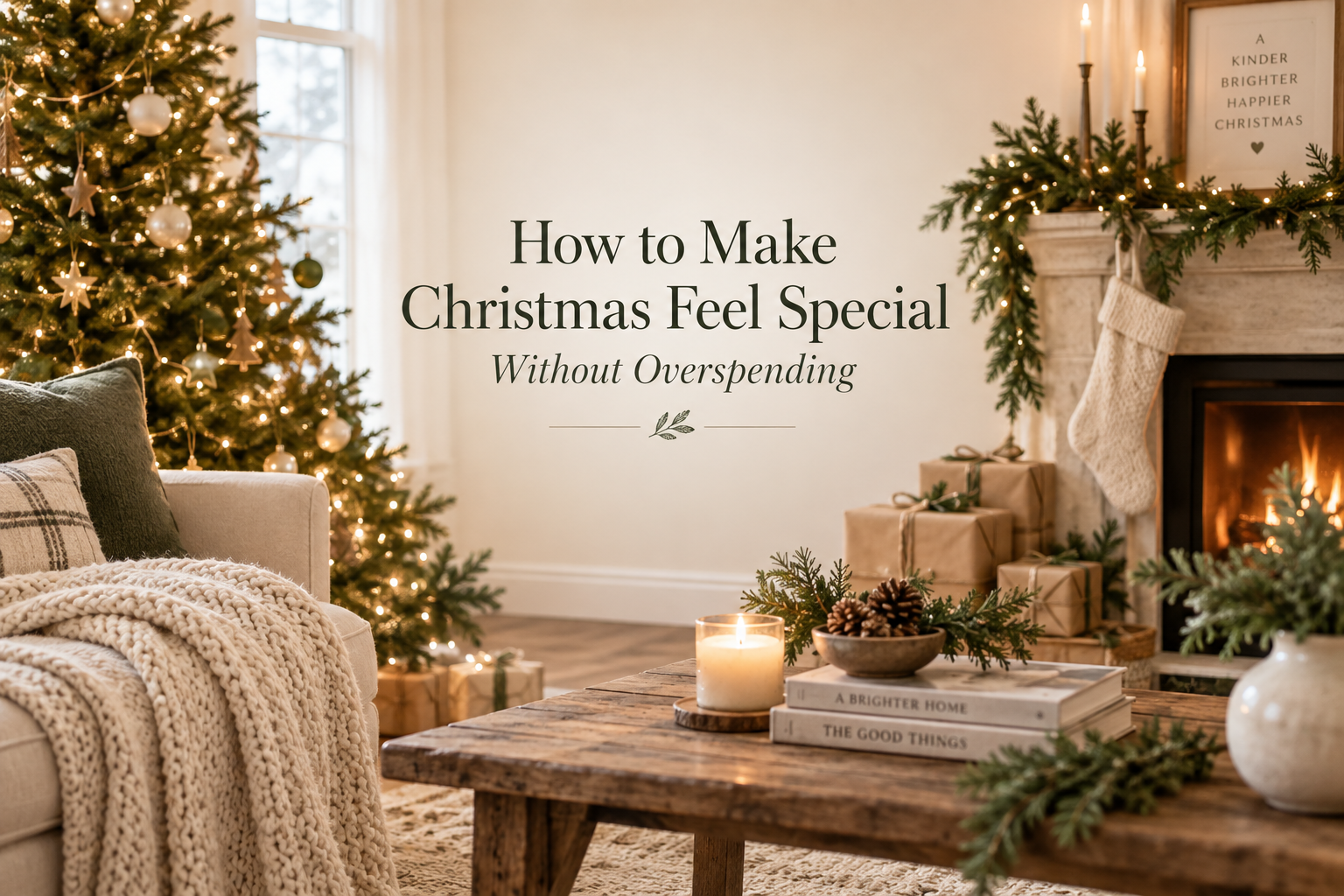
Christmas has a funny way of making us feel like we should be doing more.
More gifts. More decorations. More food. More activities. More everything.
And before you know it, a season that is supposed to feel warm and joyful can start feeling expensive, rushed, and a little overwhelming.
The good news is that a meaningful Christmas does not have to come with a huge price tag.
In fact, some of the things that make Christmas feel special cost very little — and some cost nothing at all.
If you are trying to enjoy Christmas on a budget this year, the goal is not to create a “cheap Christmas.”
The goal is to spend intentionally on the things that matter most to you and let go of the rest.
Here are practical ways to make Christmas feel cozy, memorable, and genuinely special without spending more than you can comfortably afford.
Start With the Christmas You Actually Want
Before buying anything, ask yourself a simple question:
What makes Christmas feel like Christmas to me?
The answer might be:
- decorating the tree
- baking cookies
- watching Christmas movies
- having family over
- seeing holiday lights
- cooking a special dinner
- exchanging a few thoughtful gifts
- listening to Christmas music
- spending a quiet morning together
Notice how many of those things have very little to do with shopping.
It is easy to spend money on traditions that do not actually matter to you simply because they seem like things everyone is supposed to do.
Instead, choose three or four things you genuinely care about.
Let those become your priorities.
Everything else is optional.
Set Your Christmas Budget Before the Shopping Starts
A Christmas budget is much easier to follow before you are surrounded by sales, gift guides, and “limited-time” offers.
Decide how much you can comfortably spend without creating financial stress in January.
Then divide that amount into categories such as:
- gifts
- food
- travel
- decorations
- activities
- shipping
- miscellaneous expenses
For example, if your total budget is $600, you might decide:
Gifts: $300
Food: $150
Activities: $50
Decorations: $25
Travel and miscellaneous: $75
Your numbers may look completely different.
That is fine.
A realistic Christmas budget is more useful than an impressive one.
If you want to build your holiday fund gradually, the Christmas Savings Challenge can help you break the goal into smaller weekly amounts.
Spend More on What Matters and Less on What Doesn’t
Budgeting does not mean every category needs to be equally cheap.
Maybe your family really loves Christmas dinner.
Spend a little more there.
Maybe no one cares about matching pajamas.
Skip them.
Maybe gift-giving is important to you, but elaborate outdoor decorations are not.
Put your money toward gifts.
A good holiday budget is not about cutting everything.
It is about deciding where your money creates the most enjoyment.
Make Your Home Feel Festive With What You Already Have
Before buying new Christmas décor, shop your own home.
Look for things that already create warmth:
- blankets
- candles
- baskets
- wooden trays
- string lights
- glass jars
- neutral pillows
- greenery
- serving boards
Christmas decorating does not have to mean covering every surface with holiday-specific items.
A few seasonal touches can change the entire mood of a room.
Try adding:
- greenery to a shelf
- lights around a window
- ornaments in a glass bowl
- a candle on a tray
- ribbon around everyday décor
- a cozy throw on the sofa
The same principle works in fall too. If you like decorating without buying a lot of new things, you may also enjoy 30 Cheap Fall Decorating Ideas.
Use Natural Christmas Decorations
Nature is one of the easiest places to find beautiful seasonal décor without spending much.
Depending on what is available where you live, you might use:
- pinecones
- evergreen branches
- twigs
- dried orange slices
- berries
- rosemary
- cinnamon sticks
Arrange greenery in a vase.
Fill a bowl with pinecones and ornaments.
Tie cinnamon sticks together with ribbon.
Simple often looks more intentional than a large collection of inexpensive decorations.
Just make sure anything brought indoors is clean, dry, and appropriate for indoor use.
Use Lighting to Create the Christmas Mood
Lighting can do more for a room than an entire cart of decorations.
Instead of relying on bright overhead lights in the evening, use:
- table lamps
- string lights
- battery-operated candles
- candles used safely
- tree lights
Warm, soft lighting instantly makes a room feel cozier.
And unlike highly themed decorations, many of these things can be used throughout the year.
Create a Christmas Playlist
Some of the best holiday atmosphere is completely free.
Make a playlist of Christmas music you actually enjoy and play it while:
- cooking
- cleaning
- decorating
- wrapping gifts
- having breakfast
- relaxing in the evening
It is a small thing, but music can change the feeling of an ordinary day.
Have a Christmas Movie Night at Home
You do not need an expensive night out to create a holiday memory.
Choose a Christmas movie, make something warm to drink, turn off the main lights, and bring out the blankets.
You can make popcorn, use snacks already in the pantry, or bake something simple.
For families, you could let a different person choose the movie each week.
The tradition matters more than how much you spend on it.
Make a Simple Hot Chocolate Night
A small ritual can feel surprisingly special.
Set out:
- hot chocolate
- marshmallows
- whipped cream if you have it
- cinnamon
- cookies or another simple treat
You do not need an elaborate “hot chocolate bar” with twenty toppings.
The goal is the experience, not the photograph.
Bake One Favorite Christmas Treat
Holiday baking can get expensive when we try to make ten different recipes.
Choose one or two things your household genuinely loves.
Maybe it is:
- sugar cookies
- brownies
- cinnamon rolls
- gingerbread
- homemade fudge
- a family recipe
Repeating one favorite tradition every year can become more meaningful than making something new every week.
Plan Christmas Meals Before Grocery Shopping
Holiday grocery spending can escalate quickly when we shop without a plan.
Before going to the store, decide:
- what meals you will actually serve
- how many people you are feeding
- what ingredients you already have
- which dishes genuinely matter
- which extras can be skipped
You do not need seven side dishes just because it is Christmas.
A smaller meal that everyone enjoys is better than an expensive table full of food that gets wasted.
For more practical grocery strategies, read 20 Ways to Cut Your Grocery Bill Without Making Life Miserable.
Keep the Gift List Smaller
One of the quickest ways to reduce Christmas spending is to reduce the number of gifts.
That does not necessarily mean cutting people out.
You might decide to:
- exchange one gift per person
- draw names in a larger family
- set a price limit
- give gifts only to children
- skip adult sibling gifts
- agree on experiences instead
- exchange homemade treats
Talk about it before anyone starts shopping.
You may discover other people are relieved too.
Set a Gift Budget for Each Person
Decide the amount first.
Then find the gift.
This is much safer than finding the perfect gift and deciding afterward whether you can afford it.
For example:
Mom — $40
Dad — $40
Partner — $75
Friend — $25
A spending limit can actually make gift shopping easier because it narrows your choices.
Give Useful Gifts
A thoughtful gift does not have to be expensive.
Often, practical gifts are appreciated more because they actually get used.
Think about:
- favorite food or coffee
- books
- warm socks
- kitchen items
- a framed photo
- hobby supplies
- a useful household item
- something the person mentioned needing
You do not need to impress someone with the price.
You just need to show that you paid attention.
Give Experiences Instead of More Stuff
Experiences do not have to mean expensive concert tickets or vacations.
A gift can be:
- breakfast together
- a movie night
- babysitting
- a homemade dinner
- a baking afternoon
- a picnic when the weather is better
- a day trip
- helping with a project
Some of these cost very little and may be remembered much longer than another object.
Make Homemade Gifts Only When They Actually Save Money
Homemade gifts can be lovely.
But they are not automatically cheap.
A craft that requires $40 of supplies is not necessarily a budget win.
Good inexpensive homemade options might include:
- cookies
- bread
- flavored salts
- simple photo gifts
- handwritten recipe cards
- a small plant propagated from one you already own
Choose something you enjoy making and can produce without buying lots of special equipment.
Make Gift Wrapping Part of the Budget
Wrapping paper, bags, ribbons, tape, tags, and boxes can add up surprisingly fast.
Before buying more, check what you already have.
You can reuse:
- gift bags
- boxes
- ribbon
- tissue paper
- plain kraft paper
Simple wrapping with string or ribbon can look beautiful without costing much.
Stop Buying Gifts When Someone Is Done
This sounds obvious, but it is one of the easiest holiday rules to break.
You finish shopping for someone.
Then you see something else they would like.
Then a small stocking item.
Then another little extra.
Suddenly the $40 budget becomes $70.
Once someone’s gifts are finished, mark them done.
Do not keep shopping for them.
If unnecessary purchases are something you struggle with in general, read 25 Things to Stop Buying to Save Money.
Avoid Shopping as Christmas Entertainment
Shopping centers, holiday markets, and seasonal displays are fun.
But browsing when you do not need anything often turns into spending.
If you want to enjoy the Christmas atmosphere, try activities that do not revolve around buying things:
- walk around a decorated neighborhood
- visit free holiday displays
- watch a Christmas movie
- bake at home
- listen to music
- decorate together
- call someone you have not spoken to recently
Not every Christmas activity needs a checkout line.
Look for Free Christmas Activities Nearby
Many communities offer free or low-cost holiday events.
Depending on where you live, you may find:
- tree-lighting events
- parades
- concerts
- library activities
- community markets
- neighborhood light displays
- church events
- children’s activities
Choose the ones your household will actually enjoy instead of trying to attend everything.
Make Traditions That Don’t Depend on Spending
Traditions are powerful because repetition makes them meaningful.
You might:
- decorate the tree on the same weekend every year
- make pancakes on Christmas morning
- drive around looking at lights
- bake one family recipe
- write down favorite memories from the year
- take the same family photo
- have a Christmas Eve movie night
- read the same story together
Most traditions become special because you keep doing them, not because they cost a lot.
Have a Christmas Morning Plan
Christmas morning does not need dozens of presents to feel exciting.
Create a simple rhythm.
For example:
- Christmas music
- coffee or hot chocolate
- one favorite breakfast
- gifts
- a walk
- a movie
- time together
A slower morning can feel much more memorable than rushing through piles of packages.
Use a No-Spend Day During the Holiday Season
December spending can feel constant.
Try choosing one or two days each week when you intentionally spend nothing unnecessary.
Use those days for:
- wrapping
- cooking
- organizing
- watching movies
- visiting family
- walking
- reading
- decorating
If you enjoy the idea, the 30-Day No-Spend Challenge has more ideas for reducing unnecessary spending.
Don’t Try to Recreate Social Media Christmas
Online Christmas content can make normal homes feel inadequate.
Perfect trees.
Perfect tables.
Perfect gifts.
Perfect pajamas.
Perfect kitchens.
Most real Christmases do not look like that.
Your home does not need to photograph beautifully to feel wonderful.
You do not need a new theme every year.
You do not need matching everything.
You do not need to buy something because it looks good in someone else’s home.
Take inspiration where it helps, then stop scrolling when it starts making you feel like what you have is not enough.
Leave Room in the Budget for Something Unexpected
Christmas almost always comes with an expense we forgot about.
Maybe:
- an extra gift
- a school event
- shipping
- travel
- a last-minute meal
- something that breaks
Instead of budgeting every dollar, leave a small miscellaneous category.
Even $25 or $50 can prevent one surprise from throwing off the entire plan.
Remember What Happens After Christmas
One useful question before buying something is:
Will I be happy I bought this when January arrives?
Christmas is only a few weeks.
Your financial life continues afterward.
There is nothing wrong with spending money on a holiday you love.
The goal is simply to avoid creating weeks or months of stress for a few days of celebration.
A Simple Christmas-on-a-Budget Plan
If everything feels overwhelming, keep it simple.
Step 1: Pick three priorities
Choose the three things that matter most to your household.
Step 2: Set one total budget
Decide what you can spend without relying on money you do not have.
Step 3: Make the gift list
Choose who you are buying for and set limits.
Step 4: Plan food before shopping
Use what you already have and keep the menu realistic.
Step 5: Choose free traditions
Fill the calendar with experiences, not purchases.
Step 6: Stop when the plan is complete
You do not need to keep adding things just because Christmas is getting closer.
Final Thoughts
A special Christmas is not something you can buy.
Money can absolutely make certain parts of the holidays easier and more enjoyable, but spending more does not automatically create better memories.
A cozy evening at home, a favorite meal, a thoughtful gift, music playing in the kitchen, or a tradition your family looks forward to every year can matter far more than an overflowing shopping cart.
If you are celebrating Christmas on a budget this year, decide what matters most, spend intentionally, and give yourself permission to skip the rest.
Your Christmas does not need to be expensive to feel full.
It just needs to feel like yours.
This article is for general informational and educational purposes and does not provide individualized financial advice.